

Outcome or process—which one is it?
Goodness, you could rattle this question around for a while and still be left thinking—I'm not sure? It's been THE running debate in the performance world for eons, and for good reason—it matters!

This conversation resurfaced between Robyn and me the other day as we recorded our 4th episode from our new podcast, Imagine The Good. (It’s not live yet—I’ll keep you posted) Naturally, when you have two Olympians with vastly different experiences and perspectives, you’re going to have some opposing views.
No surprise, I was the outlier in our process conversation. My rowing journey was unapologetically driven by the outcomes I pursued. Winning was the sole reason—or not losing, if we’re going to be completely honest. That’s the desired outcome that drove my training, my commitment to diet and sleep, and, of course, my reason for competing. That outcome occupied every ounce of grey matter I had during my years of competition.
On the other hand, Robyn’s reason was the complete opposite. She ran because she loved running—what a concept. She was not driven to win or not lose! Instead, she was in it for the transformative life experience on offer, stemming from her commitment to her process. Early on, she understood that the results she garnered were a direct reflection of how well she prepared herself and how she showed up to the challenges she willingly embraced.
To be clear, I didn’t come up with my little gem of a motivator all on my lonesome. No, it's what I was taught—just like many of you in all likelihood. “Eye on the prize!” Isn’t that how it goes? And, yes, I get it, focusing on the prize can and does drive extraordinary results. I guess my pushback at this stage is now, “So what—just because it can work doesn’t mean there might not be something better?”
My evolution to that something better has led me to a more nuanced understanding of what drives our best moments of performance. And the shift began with an epiphany—a realization that my obsession with outcome was actually undermining my stated purpose of winning. But it wasn’t just the actual racing part; no, it interfered with everything leading up to that moment—the training and commitment, too.
Paradox? Absolutely! The more I honed in on winning, the more I inhibited my capacity to show up to the required process as my best self. And that’s the part it seems we don’t want to acknowledge or teach our youth.
I guess my nagging and obvious question here would be, “Why?” I mean, to what end are we hoping for with this outcome-centred strategy? Because now, after a lifetime of bumpy miles travelled and my fair share of humble pie, I understand clearly that the reason I was using, in fact, was holding me back.
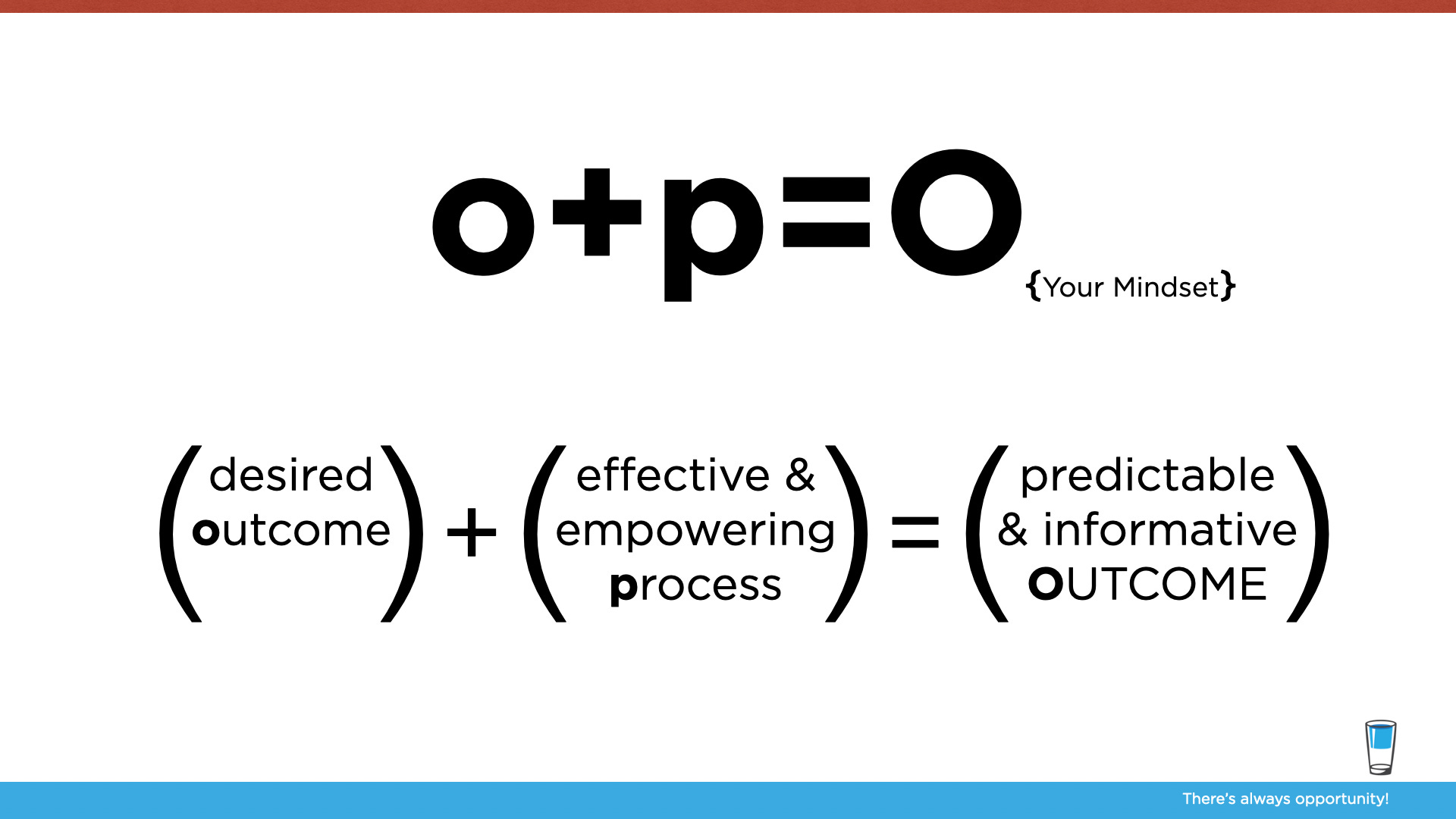
So, the question we come back to time and again is: do we focus on outcomes or on the process required to achieve them? And we frame it as such—outcome versus process. Well, I would argue it’s not a versus conversation at all. Instead, it’s an and conversation … because they hold hands—as in, they are inherently linked. Think about it; it’s the desired outcome that inspires the required process in the first place.
We can’t discuss process if we don’t know what the endgame looks like—what we’re shooting for. And it’s the eventual outcome that, unsurprisingly, resembles the strategic, effective, and empowering process used—hence the equation below. Think of them as partners: the outcome tells us where we'd like to go, and the process determines whether we get there.
One of the perks available to us with this approach is the freedom to explore—the safety to play, if you will. When we chase an outcome, we invite a stress response due to the looming threat of failing to achieve it. When it’s about process, there’s little or no threat associated with falling short, only the constructive feedback available after the performance.
Don’t take my word for it; researchers believe the same thing. Sport psychologists consistently advise elite performers to focus on controllable factors rather than uncontrollable outcomes. So that athletes who focus on execution, technique, effort, and decision-making perform better under pressure than those who are focused on winning, rankings, approval, and consequences.
Remember, the brain has limited attentional bandwidth: every moment spent worrying about the future is attention stolen from the present. The good ones know how to let go of what they can’t control and trust that the outcome will reflect their process or preparation.
Furthermore, being present and focused on the task at hand—whether it’s in business, sports, the performing arts, school, or parenting at home—the flow state available to us doesn’t occur when we’re obsessing over results. Instead, flow occurs when the challenge and our skill are relatively equal, when attention is fully present, or our self-consciousness disappears.
Is there regret for me now that I understand the importance of process? You better believe it! Knowing, after the fact, that having my mind spin stories before, during, and after training sessions or races did not in any way help me get better is a frustrating and regrettable realization.
Can I go back and change it? Well, obviously not.
What I can do instead is embrace the practice of some of these hacks. Because as I’ve said many times before, “it’s not enough to know.” We have to continuously hone our craft—regardless of what that may be. Doing the things that make us better when there’s no one there to witness—that’s part of the work.
FIVE HACKS TO BECOME MORE PROCESS-ORIENTED:
1) Define Today’s Win.
Instead of asking: “What result do I want?” Ask: “What behaviours would make today successful regardless of outcome?”
This keeps your attention where you actually have influence—as in, control the controllables. Researchers Edward Deci and Richard Ryan named it Self-Determination Theory. They found that intrinsic motivation produces greater persistence, creativity, learning, and well-being than extrinsic motivation—focusing on the result. When people become overly focused on rewards, status, recognition, and outcomes, performance usually suffers.
Instead, when they focus on mastery, growth, contribution, and learning, results naturally improve—shocker!
2) Track Inputs, Not Just Outputs.
Track the workouts you’ve completed, the number of calls you’ve made, how many pages you’ve written, or how many hours you’ve practiced. In this instance, we’re focusing on Process Goals rather than just Outcome Goals, such as how much weight you have lost, how many clients you've signed, or how many books you've sold.
Think of it this way: Inputs are the seeds. Outputs are the harvest.
3) Create “Process Triggers.”
This is a good one for bringing us back to the present. It begins with awareness—realizing we’ve been distracted by the outcome —and then giving ourselves grace and a cue, like taking one deep breath before speaking or listening first in important conversations. Simple cues interrupt outcome obsession and help us get back on track.
4) Ask Better Reflection Questions.
At the end of your day, ask: Did I show up? Did I stay present? Did I do the work? What did I learn? And how will that inform my process next time?
Notice that none of these require a successful outcome. It’s all about drilling down on our process—that’s where the successful results are born.
5) Fall in Love With The Practice.
The extraordinary is usually hidden inside the ordinary. The workout. The conversation. The page. The practice. And, yes, I appreciate that there will be days when we have to do things we don’t love. And that’s okay. Point being: the more days we hone our practices because we love doing them and how they make us feel about ourselves, the better! It ignites mastery, and that’s not nothin’!
“Success is peace of mind, which is a direct result of self-satisfaction in knowing you made the effort to become the best of which you are capable.”—John Wooden
RESOURCES:
Three books to check out: click on Book Title for more details/purchase.
1) The Inner Game of Tennis—Tim Gallwey
The classic text on quieting interference and trusting process. “The Inner Game of Tennis is not just a tennis book . . . because inner voices torture all of us—not just country-club tennis players.”—Michael Lewis, author of Moneyball and The Big Short
2) Atomic Habits—James Clear
It’s considered the best modern book on focusing on systems rather than goals. Enough said!
3) The Practicing Mind—Thomas Sterner
A hidden gem entirely devoted to learning how to enjoy the process of practice.
Three podcasts to check out: click on the Titles to listen.
1) Finding Mastery—Dr. Michael Gervais
Deep conversations about elite performance, attention, and presence.
2) The Rich Roll Podcast—Rich Roll
Many episodes explore mastery, discipline, and long-term process.
3) The Tim Ferriss Show—Tim Ferriss
Numerous interviews with world-class performers discussing systems over outcomes.
I hope these Performance Minded tips and other resources are helpful. If you have any topic suggestions or questions, please don't hesitate to contact me. Cheers!
If you’re looking for support in staying true to the process of discovering your best self, we can provide tools and insights to help you move forward and feel more confident and fulfilled in whatever role you occupy. Reach out; we’d be happy to chat.
